
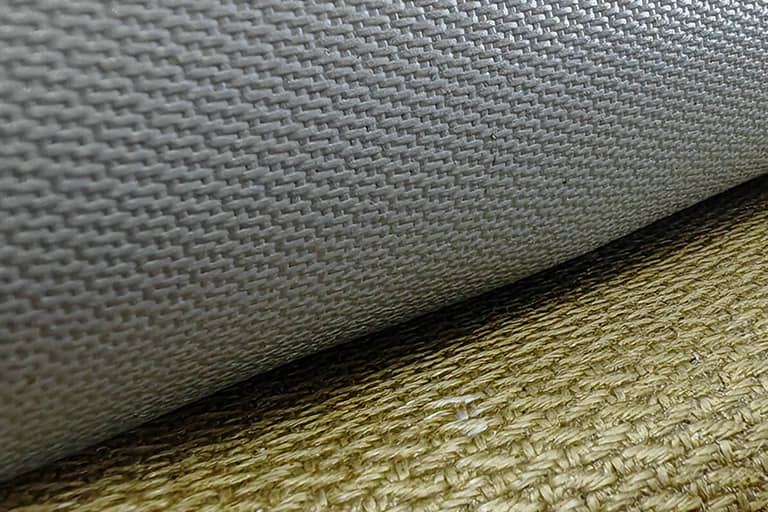
In the dynamic and often risky industrial landscape, fire prevention and protection are absolute priorities.
Among the most effective and versatile tools for passive safety, fire blankets play a crucial role.
These devices, designed to suppress small outbreaks, isolate high-risk areas, or protect operators from sparks and heat, are indispensable in numerous work contexts.
But not all fire blankets are the same; choosing the right material—fiberglass or silica fiber—depends on specific operational needs and environmental conditions.
This article will guide you through the features, properties, and applications of the different types of fire blankets, providing you with the necessary information to make an informed decision and guarantee maximum safety in your industrial environment.
The Crucial Importance Of Fire Blankets In Industry
Fire blankets are frontline tools in the fight against industrial fires.
Their primary function is to smother flames, preventing oxygen from feeding the fire, or to create a protective barrier against heat and sparks.
Their speed of action and ease of use make them ideal for managing initial emergencies or for operations involving an ignition risk.
From mechanical workshops to chemical laboratories, from welding lines to warehouses, fire blankets offer irreplaceable protection.
They are essential for protecting sensitive equipment, covering flammable surfaces during hot work, and, above all, for safeguarding personnel in the event of flame leakage or molten metal splashes.
Adequate arrangement and easy accessibility of fire blankets are fundamental steps for a complete safety plan.
Fiberglass: Economy And Effectiveness In Standard Applications
The fiberglass fire blanket is the most common and versatile type, appreciated for its excellent cost-effectiveness and solid performance in a wide range of applications.
Fiberglass is an inorganic material obtained from the fusion of silica sand and other oxides, transformed into thin filaments and then woven.
This composition gives it unique properties that make it ideal as a fire blanket.
Composition And Properties Of The Fiberglass Fire Blanket
Fiberglass is mainly composed of silica (about 50-60%) with the addition of other oxides (alumina, calcium, boron, sodium).
This makes it intrinsically non-combustible, and its properties include:
- Heat Resistance: a fiberglass fire blanket can withstand continuous temperatures up to approximately 550°C. For brief exposures, it can tolerate higher heat peaks, offering an effective barrier against sparks, metal splashes, and small fires;
- Chemical Resistance: it is resistant to most acids (excluding hydrofluoric acid) and weak alkalis, making it suitable for environments with exposure to chemical substances;
- Electrical Insulation: fiberglass is an excellent electrical insulator, which makes it safe near electrical equipment;
- Flexibility and Handling: fiberglass fabric is relatively flexible, easy to fold and store, and adapts well to covering irregular shapes;
- Low Cost: compared to other refractory materials, fiberglass is economically advantageous, making fiberglass fire blankets accessible for a wide range of companies.
Ideal Application Areas For The Fiberglass Fire Blanket
Fiberglass fire blankets are perfect for:
- Welding and Cutting: protection from sparks and incandescent slag;
- Mechanical Workshops: fire prevention caused by oil, grease, or flammable liquids;
- Laboratories: containment of small fires or protection of work benches;
- General Work Areas: as a first intervention safety device;
- Machinery Protection: temporary covering of equipment during high-risk operations.
Find out more about fiberglass fire blanket
Silica Fiber: Extreme Performance for Critical Conditions
When the temperatures involved are extreme or the operating conditions require the maximum in terms of heat resistance, the silica fiber fire blanket is the superior choice.
Silica, or silicon dioxide, is the main component of fiberglass, but in silica fiber, it is refined to a much higher purity (typically over 96% SiO2).
This process gives it exceptional thermal and mechanical properties, making it a fire blanket suitable for the most severe environments.
Composition and Properties of the Silica Fire Blanket
Pure silica fiber is distinguished by:
- Resistance to Extremely High Temperatures: the silica fiber fire blanket can withstand continuous temperatures up to 1000°C and peaks well beyond (up to 1700°C for very brief exposures, such as molten metal splashes), without degrading, melting, or releasing fumes;
- Dimensional Stability: maintains its structural integrity even at extreme temperatures;
- Flexibility when Hot: unlike some ceramic materials, silica fiber maintains some flexibility even at high temperatures;
- Resistance to Thermal Shock: it is less susceptible to breakage or cracking due to rapid temperature changes;
- Excellent Thermal Insulation: offers superior insulating performance, effectively protecting against heat transfer.
Ideal Application Areas for the Silica Fire Blanket
Silica fiber fire blankets are indispensable in:
- Foundries and Steel Mills: protection from molten metals, incandescent slag, and extremely high temperatures;
- Ceramics and Glass Industry: furnace linings, protection from intense radiant heat;
- Aerospace Industry: materials for thermal insulation of components exposed to extreme heat;
- Power Plants: insulation of turbines and high-temperature pipes;
- Military and Naval Applications: where extreme fire protection performance is required.
Find out more about silica fire blanket
Detailed Comparison: Choosing the Right Blanket for Your Needs
The choice between a fiberglass fire blanket and a silica fiber fire blanket depends on a careful assessment of operating conditions and budget.
When to Choose Fiberglass
If your applications involve temperatures below 500-600°C and you need a versatile and cost-effective solution to protect against sparks, splashes, and small fires, the fiberglass fire blanket is the ideal choice.
It is an excellent starting point for many safety needs.
When to Choose Silica Fiber
For environments with constant, high temperatures (above 600°C), or where there is a risk of contact with molten metals, intense radiant heat, or aggressive chemicals, the silica fiber fire blanket offers a superior level of protection and reliability, justifying the greater investment.
For extreme situations, a fire-resistant blanket made of silica guarantees maximum safety.
FAQs On Fire Blankets
Does the fire blanket expire?
No, fire blankets do not have an intrinsic “expiration date” like some safety devices (e.g., fire extinguishers). However, their effectiveness can be compromised by physical damage or wear; it is essential to inspect them regularly.
How to maintain the fire blanket?
Fire blanket maintenance mainly consists of periodic visual inspections. Check for the absence of cuts, tears, holes, or signs of excessive wear. Ensure it is clean and free of contaminants (oil, grease, paint) that could compromise its fire-resistant properties. It must be folded correctly and stored in a protective container, easily accessible and clearly marked.
Is the fire blanket reusable?
It depends. If a fire blanket has been used to smother a fire or has suffered significant damage (burns, melting, tearing), its integrity may be compromised and it should be replaced immediately. For simple protection from minor sparks, if undamaged, it can be reused after careful inspection and cleaning.
What is the difference between a fire blanket and a fire suppressing blanket?
The terms “fire blanket” and “fire suppressing blanket” are often used interchangeably and refer to the same type of device. Both indicate a fire-resistant blanket designed to smother small fires or protect against heat.
Where should fire blankets be placed?
Fire blankets should be placed in easily accessible and highly visible locations, near potential sources of fire (industrial kitchens, welding areas, laboratories, etc.), and their container should be clearly marked. Personnel must be trained in their correct use.