
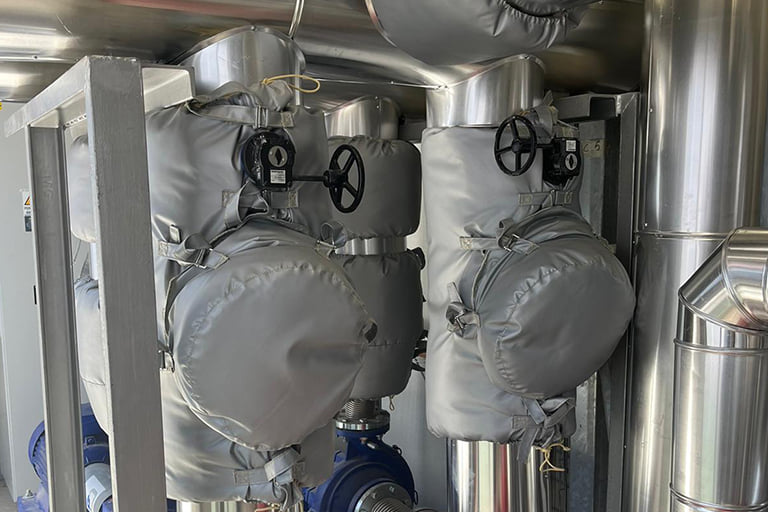
However, in many plants, the most complex and irregularly shaped components—such as valves, flanges, pumps, and turbines—often remain uncovered or inadequately insulated.
This not only generates significant thermal dispersion but also creates hazards for personnel.
The answer to this dual challenge lies in the use of tailor-made solutions: insulation jackets.
These removable and reusable thermal devices are the key to unlocking energy efficiency, facilitating maintenance, and ensuring maximum safety in every sector, from petrochemicals to pharmaceuticals, up to energy production.
In this article, we will delve into the critical applications and concrete benefits derived from adopting these high-performance insulating systems.
Insulating The Inaccessible: The Jacket Solution For Complex Components
Traditional insulation (using mineral wool and metallic cladding) is effective for straight pipes but becomes impractical for elements that require frequent inspections or maintenance.
Insulation jackets were developed precisely to overcome this limitation.
An insulation jacket is essentially a custom-made, multilayer blanket, consisting of:
- Outer covering: high-resistance technical fabrics (e.g., silicone, PTFE, or coated fiberglass) that offer chemical, water, and abrasion resistance;
- Insulating layer: high-performance materials (e.g., mineral wool, aerogel, ceramic fiber) chosen based on the operating temperature (up to 1.000°C and beyond);
- Fastening: quick closure systems (Velcro, buckles, stainless steel hooks, or cords) that allow for installation and removal in minutes.
This structure makes them perfect for:
- Valves and flanges: Insulation jackets for valves and insulation jackets for flanges are the most common applications, as they allow these critical areas to be covered without welding or permanent installations. Quick removal is essential for bolt tightening and non-destructive inspections;
- Pumps and motors: Insulation jackets for pumps and insulation jackets for motors reduce the radiant heat generated, protecting sensitive electronics and the surrounding environment;
- Turbines and conduits: Insulation jackets for turbines in power generation plants are crucial for maintaining thermal efficiency and reducing noise.
Maximum Efficiency, Minimum Waste: The Contribution Of Insulation Jackets
Thermal dispersion from uninsulated components can account for up to 20% of the total energy loss in a plant.
Valves, flanges, and fittings are true “hot spots” that radiate precious heat.The installation of insulation jackets offers an extremely fast return on investment (ROI), often measurable in just a few months.
What Are the Benefits in Terms of Energy Efficiency?
1. Reduction of Thermal Losses
Insulating an uncovered valve, which can have a surface area equivalent to meters of insulated pipe, drastically reduces the energy requirement for maintaining the process temperature.
2. Temperature Stability
Insulation jackets help maintain a more stable process temperature, improving product quality and chemical reaction efficiency.
3. Optimization of Thermal Cycles
In the polymer or plastics industry, where temperature control is vital, insulation jackets for valves ensure that heat is distributed uniformly.The strategic application of these insulation jackets transforms points of thermal weakness into zones of energy recovery.
Safety First: Protection from Contact and Fire Risk
In addition to the economic advantages, personnel safety is a crucial topic.
Many uninsulated surfaces easily exceed 200°C, representing an immediate risk of severe burns in the event of accidental contact.
Insulation jackets act as an indispensable physical barrier:
- Burn Prevention: they drastically lower the external surface temperature of the component to safe levels (60°C), protecting operators during routine operations;
- Fire Risk Containment: in environments where process fluids may leak, insulation jackets for flanges and insulation jackets for pumps prevent the fluid from coming into contact with incandescent surfaces, eliminating a potential source of auto-ignition (the so-called Diesel effect);
- Acoustic Insulation: the insulation jackets also contribute to reducing noise generated by turbines, motors, and high-pressure valves, improving the environmental comfort for operators.
Simplified Maintenance And System Longevity
The removable and reusable aspect of insulation jackets is their greatest operational advantage.
Facilitated Maintenance
- Quick Access: it is not necessary to destroy traditional insulation (with resulting disposal and costly reconstruction) to inspect valves or tighten bolts. The removal and installation of an insulation jacket takes just a few minutes;
- Longevity: made with materials resistant to wear, abrasion, and chemical agents, insulation jackets for turbines and other components have a significantly longer service life compared to rigid insulation;
- Non-Destructive Inspection: the insulation jackets can be temporarily lifted to carry out visual or thermographic checks, allowing maintenance personnel to work more efficiently and safely.
Insulation jackets therefore represent a long-term investment that reduces downtime and the costs associated with insulation maintenance and replacement.
FAQs On Insulation Jackets
What is the main advantage of insulation jackets compared to rigid insulation?
The main advantage of insulation jackets is their removability and reusability. They allow quick and non-destructive access to critical components (such as valves, flanges, and pumps) for inspections and maintenance, reducing plant downtime and reinstallation costs for insulation.
What temperatures can insulation jackets withstand?
Standard insulation jackets can withstand continuous temperatures up to 300°C – 500°C. However, models made with ceramic or Aerogel-based insulation can handle extreme temperatures exceeding 1000°C, making them ideal also for applications like insulation jackets for turbines or furnaces.
Do insulation jackets really improve energy efficiency?
Yes, uninsulated points, such as flanges and valves, are responsible for disproportionate thermal dispersion. Insulating these “hot spots” with targeted insulation jackets produces an immediate and significant effect on the reduction of energy consumption required to maintain the process temperature.
Are insulation jackets resistant to water and chemical agents?
Yes, the external coverings of our insulation jackets are made with technical fabrics (such as silicone or PTFE-coated fiberglass) that offer excellent resistance to water, oils, UV rays, and many industrial chemical agents, ensuring a long life even in aggressive environments.